


Expoziția „Pallady. Jurnal intim” itinerată la Târgu Mureș

București, 17 Noiembrie 2023
Comunicat de presă
Expoziția „Pallady. Jurnal intim” itinerată la Târgu Mureș
Muzeul Național de Artă al României și Muzeul Județean Mureș – Secția de Artă au plăcerea de a vă invita la vernisajul expoziției „Pallady. Jurnal intim”, care va avea loc luni, 20 noiembrie 2023, începând cu ora 17.00, în Palatul Culturii din Târgu Mureș.
Curator: Călin-Alexiu Stegerean– director general al Muzeului Național de Artă al României
Organizată la Muzeul Național de Artă al României (MNAR) în anul 2021 cu prilejul împlinirii a 150 de ani de la nașterea artistului expoziția „Jurnal intim” se deschide la Muzeul Județean Mureș – Secția de Artă cu o nouă selecție de lucrări din colecția MNAR la care se adaugă câteva lucrări semnate de Pallady din colecția muzeului mureșean și două dintre caietele-jurnale aflate la Biblioteca Națională a României. Titlul expoziției, „Jurnal intim” reflectă mărturisirea lui Pallady cu privire la pictura sa ca jurnal al existenței sale cotidiene și prezintă una dintre temele predilecte ale pictorului, femeia în intimitatea sa. Pe lângă explorarea felului în feminitatea ajunge obiect al operei de artă, expoziția oferă și un parcurs al evoluției stilistice a artistului, de la reprezentări în rafinate raporturi de clar-obscur la lucrări ulterioare caracterizate de reprezentări angulare, culori în a plat și edificarea unui definitiv stil propriu. Este un demers exclusiv curatorial al cărui scop este de a releva complexitatea operei palladiene prin corelarea scrierilor și lucrărilor artistului.
Pe de altă parte, această expoziție marchează o nouă dimensiune a colaborărilor MNAR cu alte muzee din țară prin itinerarea unor expoziții de anvergură care au atins un nivel considerabil de notorietate și calitate cultural-artistică.
Vă invităm să vizitați această expoziție reunind cele mai importante lucrări ale artistului pe tema feminității care va fi deschisă în perioada 20 noiembrie 2023 – 14 aprilie 2024, în sălile de expoziții temporare din Palatului Culturii. Program de marți până vineri, între orele 09.00 și 16.00, sâmbăta și duminica, între orele 09.00 și 14.30. Luni închis. Prețul biletului de intrare este de 7 lei adulți și pensionari, 3 lei elevi și studenți.
Parteneri: Asociația Prietenii Muzeului Național de Artă al României, Asociația Atrium Musei, Crama Villa Vinèa, Primăria Târgu Mureș
Parteneri media: AGERPRES, Duna TV, Erdély FM, Erdély TV, Evenimente muzeale.ro, Invie Tradiția, Kultura.hu, Krónika.ro, Marosvásárhely Rádió Románia, Maszol.ro, Modernism.ro, Népújság, PROPAGARTA, Punctul.ro, Rádió GaGa, Radio Târgu Mureș, Radio România Actualități, Székelyhon, TVR, Visit Mures, Zi de Zi
Întâlnire la muzeu cu Ana Blandiana

„Întâlnire la muzeu” este un proiect care își propune să medieze contactul publicului cu personalități din varii domenii ale culturii pe subiecte aflate la interferența diverselor genuri artistice. Evenimentul face parte din seria activităților desfășurate în zilele în care spațiile expoziționale sunt închise.
De data aceasta, invitata „Întâlnirii la muzeu” este cunoscuta scriitoare Ana Blandiana.
Discuția cu Călin Stegerean, director general MNAR, va porni de la volumul „Mai-mult-ca-trecutul”, recent apărut la editura Humanitas sub semnătura doamnei Ana Blandiana. Acesta cuprinde un jurnal al perioadei începute în august 1988 și încheiate în preajma Revoluției din anul 1989. Atunci, autoritățile comuniste îi impuseseră autoarei o serie de restricții în urma publicării unui volum de poezii pentru copii, în care motanului Arpagic îi erau atribuite caracteristici desprinse din cultul personalității lui Nicolae Ceaușescu.
Dincolo de descrierea presiunilor la care a fost supusă atunci autoarea, jurnalul este și ocazia unor observații lucide ce privesc profilul moral al unor personalități culturale și politice ale epocii și se constituie într-o mărturie dramatică a anilor de privațiuni care au marcat poporul român în ultimii ani ai comunismului.
Dialogul cu Călin Stegerean nu se va limita însă doar la evocarea acelei perioade și la consecințele sale peste timp, în prezent, ci va dezvălui publicului momente de neuitat ale întâlnirii celei mai importante poete a României de azi cu locuri ale culturii și artei.
Ana Ioana Macaria, actriță a Teatrului Bulandra, va citi din opera Anei Blandiana fragmente ilustrative pentru parcursul dialogului.
Luni, 16 octombrie, 2023, ora 18.00
Parterul Galeriei Naționale, Calea Victoriei nr. 49-53
Accesul se face pe baza biletului de intrare în valoare de 12 lei.
The Concert of Paintings in the Art Collections Museum
Catch your breath while admiring the dialogue between two arts: music and paiting. By following the tour we sugest, you will not only discover the link between visual artists and musicians, but also the mutual admiration expressed in the work of arts of these great spirits.

Corneliu Baba Collection – George Enescu
„Among the great artists of the world, Enescu stayed with me as an all-encompassing icon of the genius artist and of one of the noblest thinkers in art. I was still working on the portrait when news of his death reached me. I finished it after several months of tormenting work. It was presented at the Dalles Hall exhibition (1955), it was the key piece in the room, but critics hardly accepted it. Nobody understood, except perhaps those who knew his huge spiritual personality, why I imagined him with his head lowered, his back a little hunched, with that figure characteristic only to him, and why I didn’t see in him a proud and assured musician.
[...] The portrait is now in my workshop, where I paint a second version, made to express what was not expressed earlier.” (Corneliu Baba, Confessions and Diaries, vol. I, 1944 – 1965, The National Museum of Art of Romania, Bucharest, 2018)
Iosif Iser Collection – Harlequinade, Singer in blue with a musical instrument, Interior with two odalisques – Paulina and Mariana, Oriental Woman
On this second stop we propose not only this artist’s works, but also objects that belonged to him: four musical instruments were included in the exhibition. They were used by the artist as props for scenes with few characters interpreted by models. The artist himself decided their ‘pose’ with various attitudes and accessories.
One of the frequent motifs in his famous oriental women compositions is the theorbo, a string instrument from the lute family, well used by Iser as an accent in numerous paintings and drawings, in the late 1920s and especially in the early 1940s.
Iosif Iser often compared the drawing exercise to the musical one: “I was drawing constantly. The drawings are always for me what technique exercises are for a pianist.”
Elena end Anastase Simu Collection – Gentleman with a lute (Jacques Henri Lambert) and The Chorus (Hedwig Mechle Grossmann)
Lawyer, diplomat and politician, Anastase Simu (1854 – 1935) was one of the most important Romanian collectors of Western European art.
Gentleman with a lute, by Jacques Henri Lambert was acquired by Simu in Paris in 1907, the very year it was painted. The author distanced himself from the growing modernist trends, choosing subjects disconnected from immediacy, usually scenes with one or several characters dressed mostly in 17-th century European costumes treated in an unequivocally figurative style.
The Chorus, by the German artist Hedwig Mechle Grossmann, stands between the genre scene and the group portrait. The characters look in different directions as if interpreting a polyphonic score, resulting in a dynamic image. The lack of depth of the composition, while all characters are placed in the foreground, as well as the angle from which they are seen make the onlooker to feel accepted in the space of the painting and to almost become the intimate spectator of the concert.
Garabet Avachian Collection – Still life with guitar (Lucian Grigorescu)
Considered by the art critics one of the best Romanian colourists, Lucian Grigorescu always searched, through the orange shade in his paintings, for the red shade of the soil in the Dobruja province where he had spent his childhood. The southern colours, the brown, the orange, the ochre, are present in Still life with guitar as part of the chromatics closely linked to his biography.
Collector Garabet Avachian was a violin professor at the Ciprian Porumbescu Conservatory in Bucharest, where for a long time he taught many a virtuoso of this instrument.
Elisabeta and Moise Weinberg Collection – Interior in the artist’s studio (Gheorghe Petrașcu), Tatar woman with violin, Barbu the violinist , Still life with musical instruments (Iosif Iser)
The Elisabeta and Moise Weinberg Collection proves both the friendship between the collectors and the artists, but also the latters’ sensitivity to music.
To Iosif Iser, inspiration from the imaginary world of music is almost a personal hallmark. Thus it is only natural that his works featuring musical instruments are present in the Elisabeta and Moise Weinberg Collection, the Weinbergs being some of his keenest collectors. In the paintings Tatar woman with violin (1945) and Still life with musical instruments (1940), the instruments are attentively placed and seen from a monumentalizing angle.
In the same collection one can admire a small pseudo-portrait, in gouache, of Barbu the Violinist (Rom. Barbu Lăutaru) and his violins. This was a famous musician in the Romanian Principalities in the first half of the 19th century and became a favourite subject for Iser between 1930 and 1940.
One should not miss the painting by Gheorghe Petrașcu Interior in the artist’s studio where the elements of the composition (the easel, the bookcase, the table and instruments) revolve around the central image of a guitar. The studio, a space for toiling, learning and delecting, may synthesize, according to Petraşcu, the concept that some cultural historians named ’the modern system of the arts’.

The Concert of Paintings in the Romanian Modern Art Gallery
A society undergoing radical change, its artistic life receiving new influences and establishing its new directions, an art scene able to place the artist among fashion darlings, a new music marked by Enescu’s genius… This might be the backdrop against which Romanian modern art takes shape at the end of the 19th and beginning of the 20th century.

Here are the few stops of an imaginary tour in the Romanian Modern Art Gallery:
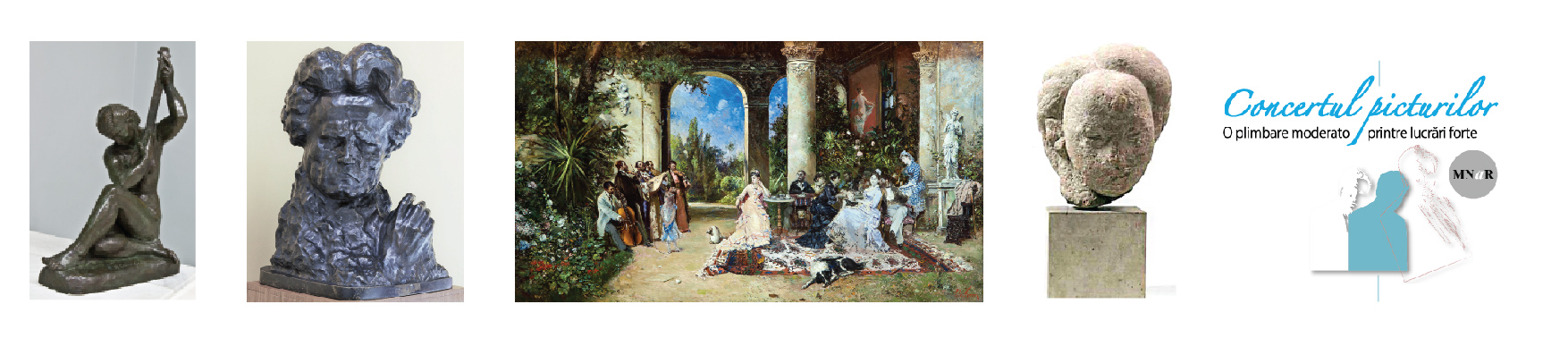
Theodor Aman (1831 – 1891), founder of the first Romanian art schools in Jassy and Bucharest, painter and draftsman, teacher and member of the Academy, was an artist belonging to his time. His works reflect the trends in the Bucharest high society to which he himself belonged: Party with musicians, Dress Ball in the artist’s workshop, Still life with a cello, etc. (Room 1)
Also named “the painter of nature”, Ștefan Luchian (1868 – 1916) is considered a passionate master of bright bold colours seen under intense light. One day, just before his tragic death, George Enescu played for him for hours, out of respect and love for Luchian’s art. (Room 3)
Next stop: Room 5, dedicated to sculptor Dimitrie Paciurea (1873 – 1932), Romanian artist known for the mysteriousness and the forceful symbolism of his Chimeras. Looking through the series dedicated by the artist to international personalities one remarks The Bust of Beethoven. Created in 1912, it embodies, in a symbolic approach, the essential creator by excellence.
The Avant-garde reunited artists who refused tradition and tempted the re-invention of art: Marcel Ianco (1895 – 1984), Max Herman Maxy (1895 – 1971), Arthur Segal (1875 – 1944), Victor Brauner (1903 – 1966). They all did painting and sculpting, decorative art and stage design, posters and architecture. How would music be seen through the eyes of an Avant-garde artist? You can find out in the Café Concert by Marcel Ianco. (Room 6) Maybe more than anyone else, Constantin Brâncuși (1876 – 1956), through his search for essences, his volumes so synthetic, full of energy and vibration, makes one wonder: what music was Brâncuși listening to? (Room 7)
The final stage of the tour in the Romanian Modern Art Gallery (also “drawn” for you in The Concert of Paintings) is in Room 11, in front of the Feminine Nude with a Mandolin. Created in 1941 by Romanian sculptor Boris Caragea (1906 – 1982), the work reminds the Greek classic era through its subject, composition and vigor of volumes, but at the same time the creations of French sculptor Aristide Maillol (1861 – 1944). Sculptor Boris Caragea is also the author of the 1961 statue of George Enescu, now to be seen in the vicinity of the National Music University in Bucarest.
The Concert of Paintings in the European Art Gallery
In your tour through the European Art Gallery, while admiring works by great artists such as El Greco, Rubens, Rembrandt or Monet, do not miss the five stops we prepared for the special tour dedicated to music as presented in the artwork on music subjects. You will be persuaded that many European artists were inspired by music, a language not only universal but also beyond time.

Jacopo Amigoni - Portrait of singer Carlo Broschi named Farinelli
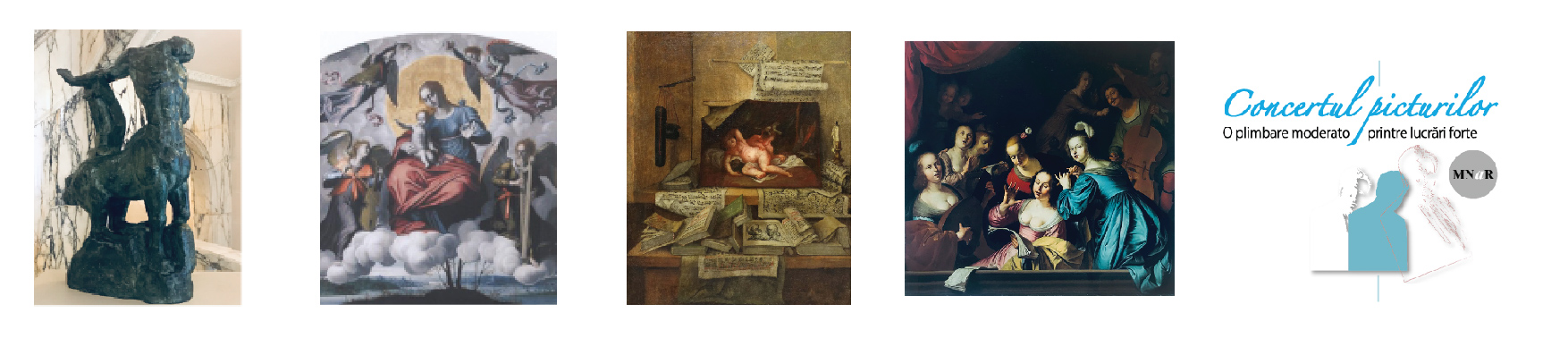
The first stop on the musical tour in the European Art Gallery is with the Italian School and the “Portrait of singer Carlo Broschi named Farinelli”. In a grandiose arhitectural decor, the famous castrato Farinelli, presented in full size, is being crowned with laurels by Euterpe, muse of music. The winged feminine character in the background symbolises Fame, while the bust of the god Apollo or the garland lead to the idea of Farinelli’s artistic supremacy.
The author is Jacopo Amigoni (1682-1752), one of the most important representatives of rococo painting in Europe. Amigoni met Farinelli in person and made several portraits of him. The one shown in NMAR is considered the most complex.
Anonymous German artist from the XVIII-th century- Still Life With Music Notes
If you stop in the rooms showing works belonging to the German school, you can admire a XVIII-th century still life, painted in trompe l’oeil. The objects are exhibited on two wooden shelves, with a wall as a background. In the centre of the composition one discovers a small painting representing two children and several pigeons; the small painting is surrounded by music sheets. In the upper left register there is a knife thrust into the wall and from it an inkpot and a sheath for pens are hanging.
This work is now shown especially for the Campaign entitled The Concert of Paintings. A „moderato” walk among „forte” artwork.
Pedro Campaña – The Triumph of the Virgin Surrounded by Angels
For the third stop on this musical trip we propose a Renaissance religious work from the Spanish School: ”The Triumph of the Virgin Surrounded by Angels”. This painting shows the Virgin Mary holding baby Jesus in her arms. She is surrounded by four angels, two of them holding in their hands a harp and a violin. Musical themes are often present in religious works and they usually symbolize celestial harmony.
This painting was created by Pedro Campaña (1503–1580), considered to be one of the greatest religious painters in Seville by the mid-XVI-th century. Mainly inspired by Rafael, Peter de Kempeneer -- by his original name -- was a true Renaissance artist: painter, architect, sculptor, mathematician, astrologist, engineer.
Abraham Van der Schoor – The Concert
For a tour entitled „The Concert of Paintings”, the piece „The Concert”, shown in the Dutch School Rooms, is an absolute must.
In the XVII-th century, music was a popular passtime among the middle classes. Thus, such picturesque images, of musicians and robust singers, seen by the Flemish painters in theatrical lightings, exerted a powerful attraction on the Dutch artistic milieu. Abraham Van der Schoor, author of this painting, obviously did not escape it.
There are few informations on his life and career. But from the few of his works that reached us, one can see his attraction for the topic of the concert.
Émile-Antoine Bourdelle – Dying Centaur (second study)
Last stop: French School Rooms, to see the only sculpture on this musical trip. Made in bronze in 1914 by Émile-Antoine Bourdelle (1861 – 1929), the sculpture ”Dying Centaur” symbolises the sad destiny of an artist who wrestles with his own life and dies holding his lyre that represents his artistic ideal. A melancholic work on the death of the artist no longer credited by his audience.
Considered one of the most important modern sculptors, Bourdelle was an apprentice in the workshop of Auguste Rodin, whose influence is visible in Bourdelle’s early work.

Galeria de Artă Orientală
Galeria de Artă Orientală reunește piese de mare valoare artistică și culturală, provenind din Egipt, Grecia, Bulgaria, Turcia, Siria, Daghestan, Azerbaidjan, Iran, Turkmenistan, Uzbekistan, India, China și Japonia, selectate din cel mai important și mai valoros patrimoniu de artă orientală și extrem orientală din țară. Acesta a fost constituit pe parcursul a peste șaptezeci de ani, prin transferuri, donații și achiziții ale Muzeului Național de Artă al României.

Locuri ale artei și istoriei noastre
Sala Tronului, Sufrageria Regală și Scara Voievozilor pot fi vizitate în programul obișnuit al MNAR.
Biletele de intrare se achiziționează de la casa de bilete din Galeria de Artă Europeană și online de pe www.booktes.com .
Preț bilet: 24 lei / 12 lei / 6 lei.
Fotografiatul este permis cu telefonul mobil.

Muzeul K.H. Zambaccian
Colecția Krikor H. Zambaccian (1889-1962), una dintre cele mai bogate şi valoroase colecții de artă din România, cuprinde capodopere ale picturii și sculpturii românești moderne, alături de pânze semnate de renumiți artiști francezi: Delacroix, Corot, Renoir, Sisley, Pissarro, Cézanne, Picasso, Matisse.


