Accessibility Tools

Visiting hours:
The National Museum of Art of Romania, the Theodor Pallady Museum and the K. H. Zambaccian Museum can be visited: Wednesday-Friday 10am-6pm

Saturday-Sunday 11am-7pm, Monday and Tuesday closed. Free entry on the first Wednesday of the month.
The Art Collections Museum: Monday, Tuesday and Friday, 10am-6pm, Saturday and Sunday 11am-7pm, closed Wednesday and Thursday. Free entry on the first Tuesday of the month.
Last entrance: 1 hour before closing for The National Museum of Art of Romania and the Art Collections Museum and 30 minutes for the Theodor Pallady Museum, the K. H. Zambaccian Museum and the temporary exhibitions.
For guided tours, please make a reservation at secretariat@art.museum.ro at least 7 days in advance. 
The National Museum of Art of Romania – main building:
Holiday schedule: December 27–28 – open to the public.
After the holidays: January 3–4 – open; January 7–11 – open. On December 24, 25, 26, and 31, 2025, and January 1 and 2, 2026, the museum will be closed.
The Oriental and Decorative Art Gallery will be open on December 17, 18, and 19, and will be closed from December 20, 2025, to January 11, 2026. 
Starting January 12, the normal schedule will resume.


The National Museum of Art of Romania
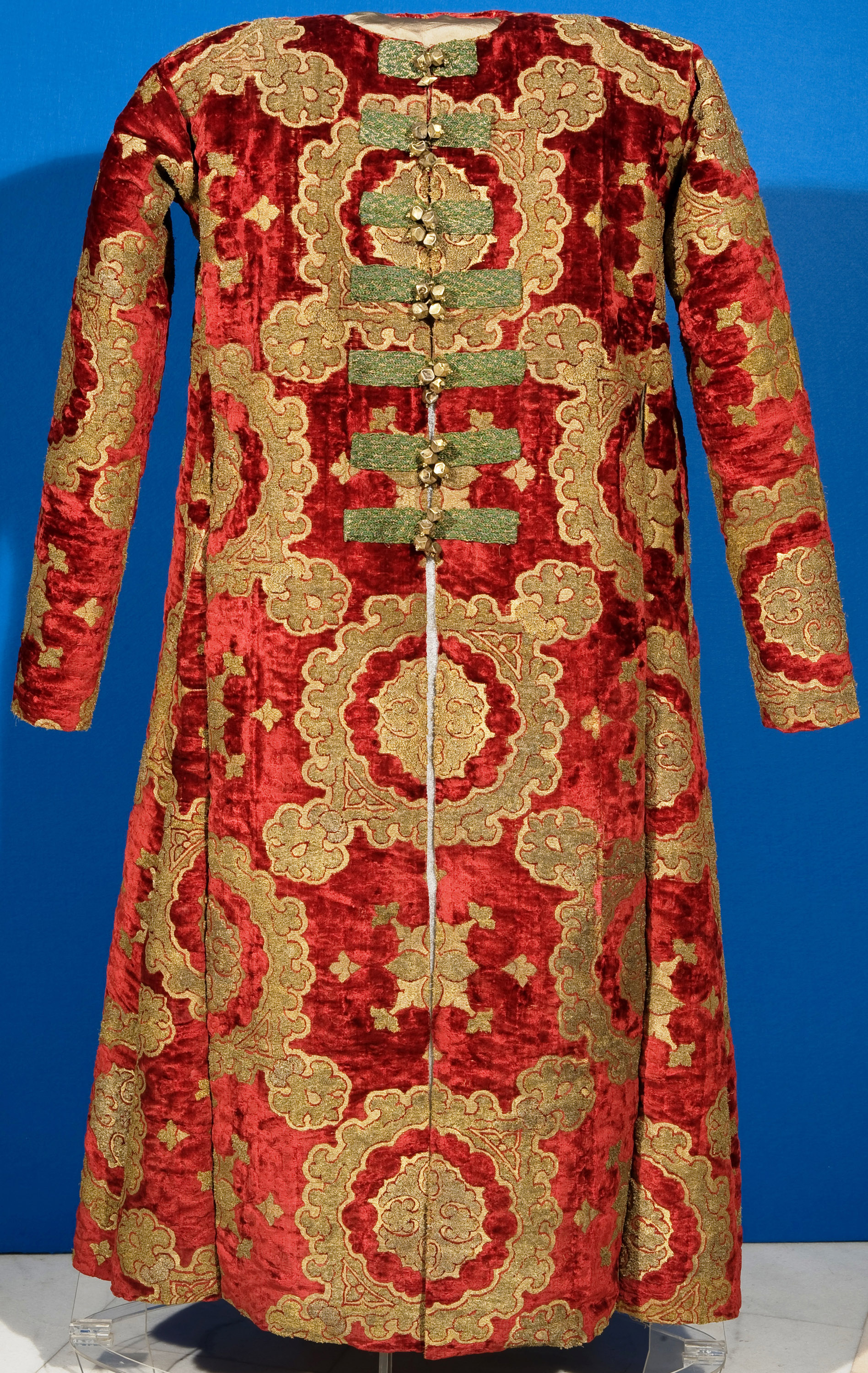
Kaftan
Artwork description
Kaftan
Silk brocade, silver gilt thread
Height: 144 cm
Wallachia. Italian fabric (Milan ?)
c. 1480-1490
Inv. 15620 / T 423
Artwork location
Romanian Medieval Art Gallery, room 4
Sign language video
Sign language video

The kaftan from the Bistriţa monastery is made of luxurious Italian brocade, the decorative patterns of which resemble embroidery but are the result of a special weaving technique. Museum inventories record a sumptuous grave cover, bestowed by the Craiovescu brothers to the monastery they founded around 1490. Closer inspection revealed the cover consisted of many smaller pieces cut for a kaftan, hence its restoration as a costume. The thick red velvet is decorated with vegetal motifs of Chinese origin which owe their relief to the employment of gilded silver thread.  Both ornamental motifs and execution techniques are indicative of an Italian workshop, active around 1480-1490. Particularly expensive, their cost the equivalent of vast properties, such fabrics and the costumes made of them were an important statement of power and status.

The kaftan derives its form from the ancient Persian riding costume. The costume was later adopted by Byzantine officials, followed in their turn by high-ranking Ottoman officials. Boyars at the courts of Romanian princes also wore caftans as a sign of the office held. 

As the Craiovescu brothers bestow the costly costume onto their foundation they followed a wider European practice among aristocrats, who donated rich costumes to be made into priestly vestments. Prince Neagoe  Basarab, a blood-relative of the Craiovescu family, also donated a rich kaftan to the Bistrița monastery to be specifically turned into a reliquary cover. 


See more works in the Romanian Medieval Art Gallery

Romanian Modern Art Gallery

Romanian Modern Art Gallery

The Romanian Modern Art Gallery tells the story of Romanian art from the mid-nineteenth to the late twentieth century. Representative works by Theodor Aman, Nicolae Grigorescu, Ioan Andreescu, Theodor Pallady among others, illustrate connections with contemporary French painting while those of M.H. Maxy, Marcel Ianco, Victor Brauner trace the contribution of Romanian art to the European avant-garde of the 1920s and 1930s. Early sculptures by Brancusi reveal the master’s will to break away from academic tradition and find a way of his own. 

Nostalgia. Remembrance. Recapture European Landscape and Ruins in the 16th-19th Centuries

Nostalgia. Remembrance. Recapture European Landscape and Ruins in the 16th-19th Centuries

Curator: Malina Contu
Visiting hours: Wednesday - Sunday (10:00 to 18:00)
Last entrance: 17:30
Ticket price: 12 lei/ 6 lei/ 3 lei

Theodor Pallady Museum

Theodor Pallady Museum

The museum brings centre stage a core selection of paintings by Theodor Pallady. Together with over 800 prints and drawings from the artist’s Parisian years, these are part of the Serafina and Gheorghe Răut collection, donated to the Romanian state at the end of the 1960s. The collection also comprises French, Dutch, English and Spanish paintings, European furniture and sculpture and a host of various objets d’art which speak eloquently about the manner in which Romanian inter-war intellectuals tried to emulate general trends.

Facebook Page

Acest site folosește cookies

Folosim module cookie pentru a vă pune la dispoziție caracteristici de social media și pentru a analiza traficul. Navigând în continuare, vă exprimați acordul asupra folosirii acestora.