Accessibility Tools

Visiting hours:
The National Museum of Art of Romania, the Theodor Pallady Museum and the K. H. Zambaccian Museum can be visited: Wednesday-Friday 10am-6pm

Saturday-Sunday 11am-7pm, Monday and Tuesday closed. Free entry on the first Wednesday of the month.
The Art Collections Museum: Monday, Tuesday and Friday, 10am-6pm, Saturday and Sunday 11am-7pm, closed Wednesday and Thursday. Free entry on the first Tuesday of the month.
Last entrance: 1 hour before closing for The National Museum of Art of Romania and the Art Collections Museum and 30 minutes for the Theodor Pallady Museum, the K. H. Zambaccian Museum and the temporary exhibitions.
For guided tours, please make a reservation at secretariat@art.museum.ro at least 7 days in advance. 
On November 19, 20 and 21, 2025, the Throne Hall, the Royal Dining Room, and the Voivodes’ Staircase will be closed to the public. Thank you for your understanding!
Between 20–23 November 2025, the Theodor Pallady Museum and the K. H. Zambaccian Museum will be closed to the public. Thank you for your understanding!


The National Museum of Art of Romania

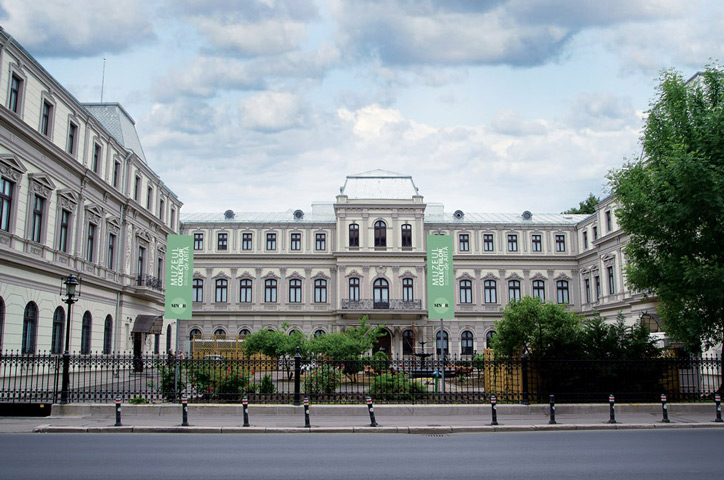
1837 - Wallachian Prince Alexandru Ghica moves his official residence to the large mansion built between 1812 and 1820 by boyar Dinicu Golescu on the site of the present-day south wing of the Museum.

1859 - 1866 - Following the Union of the Romanian Principalities of Moldavia and Wallachia, Prince Alexandru Ioan Cuza uses the house as a ceremonial palace and a residence.


1866 – German Prince Carol (Karl) of Hohenzollern-Sigmaringen (as of 1881 King Carol I of Romania), ruling Prince of the Romanian Principalities, takes official residence here. Until 1881, the building sustains only minor alterations (mostly additions) designed to meet growing administrative needs.

1882-1906 - King Carol I employs French architect Paul Gottereau and Czech architect Karel Liman to enlarge and decorate the palace. By 1906 the palace becomes the winter residence of the Royal Court.

1926 - In December, a fire destroys the central part of the palace and the Throne Hall. King Ferdinand I and Queen Marie (granddaughter of Queen Victoria and of Tsar Alexander II of Russia) commission architects N.N. Nenciulescu and Karel Liman to carry out major reconstruction works. The government recommends that at least one floor be added above the Throne Hall.

1930-1937 - King Carol II embarks on rebuilding and extending the palace; architect Arthur Lorentz designs the plans. In 1935 the central wing is completed. The old city mansion erected by Dinicu Golescu is demolished to provide room for a new south wing with architect N.N. Nenciulescu once again in charge of the project.

1938-1940 - The royal palace is further extended toward the north, along Ştirbei Vodă Street.

1944 - During massive air raids in April and August, about 80 heavy bombs hit the palace; the Ştirbei wing is partly destroyed.

1948 - Following the forced abdication of King Michael I in December 1947 and the communist takeover, the royal palace is nationalised in June. The palace plays host to both the Council of Ministers and the national museum of art. The latter had been officially established as the ‘King Carol I’ National Museum of Art in 1946.

1950-1954 - On 20 May 1950, the National Gallery, displaying works by famous Romanian artists, is officially inaugurated. Over the following four years the Foreign Art Gallery, exhibiting both European and Oriental art, and the Department of Romanian Medieval Art will open to the public.

1961 ­ The Museum is relocated from the south to the north wing, completely rebuilt by that time. It stayed open to visitors until 1989.

1989 - The palace is caught in the crossfire of December events in December; both building and  collections are damaged (over 1,000 works of art, some of which completely destroyed).

1990 - The Museum is granted use of the entire palace.

1990-2000 - The Museum’s permanent display is closed to the public, as the building undergoes extensive restoration, including the overall refurbishment of exhibition areas.

2000 – 2013 – Gradual reopening of permanent galleries: European Art Gallery (2000), Romanian Modern Art Gallery (2001), Romanian Medieval Art Gallery (2002). In 2013 the restoration of the central wing, comprising the Throne Hall, also came to an end.
The European Decorative Art Gallery

The European Decorative Art Gallery

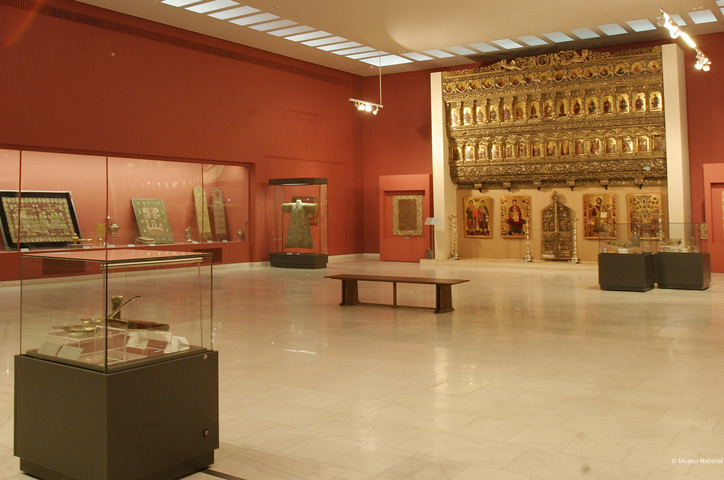
Divided into six rooms, illustrates four centuries of the history of taste and refinement, of European innovations, manufactures and craftsmen from Austria, Belgium, Czech Republic, Switzerland, France, Germany, Italy, Holland, Spain, Russia of the 16th-19th centuries and completes the museum's permanent collections, together with the European Art Gallery and the National Gallery.

Portrait of a Child

Portrait of a Child

On the occasion of International Children's Day, the National Museum of Art of Romania and the organization Save the Children are organizing a special program. 

K.H. Zambaccian Museum

K.H. Zambaccian Museum

Art collector and critic Krikor H. Zambaccian (1889-1962) put together one of the richest and most valuable private collections in Romania. In the 1940s Zambaccian had the house purpose built so as to enable him to display the paintings, sculptures, prints and drawings and furniture he had acquired over more than half a century. Both the collection and the house were donated by him to the Romanian State in 1947.
In celebration of his deed, Zambaccian was made a member of the Romanian Academy.
The collector’s portfolio of Romanian artists offers a brief but dense overview of modern Romanian art, covering representative paintings by founding figures like Theodor Aman, Nicolae Grigorescu, Ioan Andreescu, classical modernists like Ștefan Luchian, Nicolae Tonitza, Theodor Pallady and Gheorghe Petrașcu, and post-war figurative painters like Corneliu Baba, Alexandru Phoebus and Horia Damian. Sculptures by Brâncuși, Milița Petrașcu, Oscar Han and Cornel Medrea reflect Zambaccian’s preference for a more traditional vein of modernism. To create a context for Romanian art and enhance his prestige, Zambaccian also acquired works by Cézanne, Picasso, Matisse, Bonnard, Utrillo, and Marquet, which lend his collection a profile unmatched in Romania.  

Facebook Page

Acest site folosește cookies

Folosim module cookie pentru a vă pune la dispoziție caracteristici de social media și pentru a analiza traficul. Navigând în continuare, vă exprimați acordul asupra folosirii acestora.