Accessibility Tools

Visiting hours:
The National Museum of Art of Romania
, the Theodor Pallady Museum and the K. H. Zambaccian Museum can be visited: Wednesday-Friday 10am-6pm
Saturday-Sunday 11am-7pm, Monday and Tuesday closed. Free entry on the first Wednesday of the month.
The Art Collections Museum: Monday, Tuesday and Friday, 10am-6pm, Saturday and Sunday 11am-7pm, closed Wednesday and Thursday. Free entry on the first Tuesday of the month.
Last entrance: 1 hour before closing for The National Museum of Art of Romania and the Art Collections Museum and 30 minutes for the Theodor Pallady Museum, the K. H. Zambaccian Museum and the temporary exhibitions.
For guided tours, please make a reservation at secretariat@art.museum.ro at least 7 days in advance.
For visits to our museum without guided tours there is no reservation necessary.

Starting with February 4, 2026, the Theodor Pallady Museum is temporarily closed for reorganization and renovation works.

The National Museum of Art of Romania
Anonymous painter - Boyar Manolache Manu
Artwork description
Anonymous painter
Oil on canvas
0,700 x 0,575
Moldavia
1841
Inv. 2395
Artwork location
Romanian Medieval Art Gallery, room 7

Slightly gauche and obsolete even as it was painted, the portrait of Boyar Manolache Manu writes a page in the visual history of Romanian society in the first half of the 19th century.

At the time, Manolache Manu was a member of the Moldavian government, his rank roughly the equivalent of internal affairs minister and hence assimilated to Ottoman administration. The caftan and headdress are indicative of this status. The fur-lined caftan is open so as to show the tulip pattern on his white shirt, tulips being the favourite flowers of sultans. Both the caftan and the pear-shaped headdress are oversized compared to his face and slim figure. Well past his prime, Manu changed the rich beard of traditional boyars over a well-trimmed chin beard and moustache, more in line with the Western fashion of the time.

Beyond him are displayed four thick volumes in French, suggestive of his spiritual pursuits (L’Histoire Sainte and L’Image de la Vertu).

In stark contrast to Manolache Manu, his wife, Sultana Manu, née Mavrogheni, wears a typically Western dress, even if out of fashion. Together the two portraits are indicative of the limitations of Romanian intelligentsia as it struggled along the path to modernization.
See more works in the Romanian Medieval Art Gallery

Romanian Medieval Art Gallery

Romanian Medieval Art Gallery

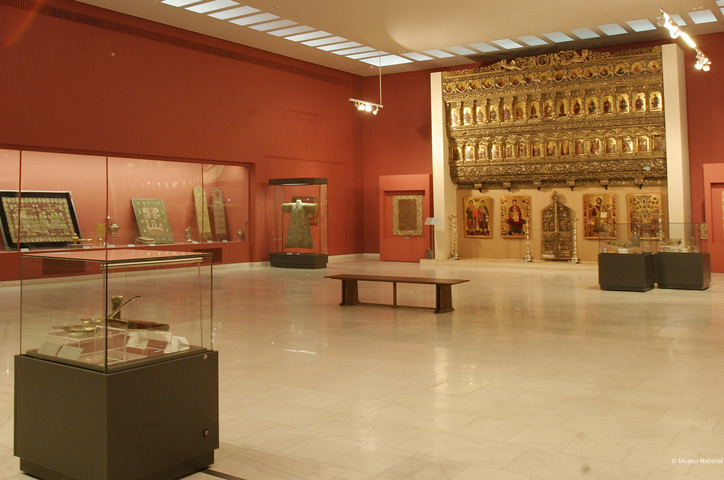
Over 900 icons, mural paintings, embroideries, manuscripts, silverware, woodcarvings, many of them unique, amply survey Romanian art from the 14th – to the early 19th century. Items on display showcase developments in Moldavia, Wallachia and Transylvania, reflecting the intricate manner in which a traditional Byzantine layer blended in Oriental as well as Western influences to generate original local art forms.

The Stories of the Cross: Miniature Sculpture of Byzantine Tradition

The Stories of the Cross: Miniature Sculpture of Byzantine Tradition

Curator: Lucreția Pătrășcanu

The Art Collections Museum

The Art Collections Museum

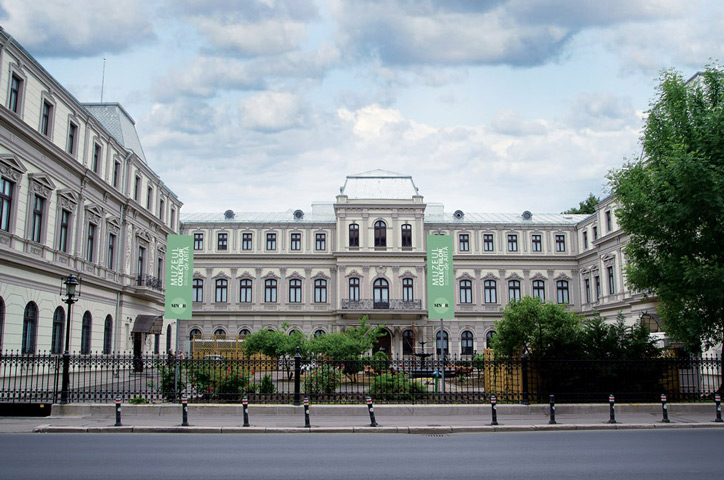
Inaugurated in 1978 as a Department of the National Museum of Art of Romania, the Art Collections Museum showcases artistic interests that prevailed in Romanian society from the early 20th century onward. Over 30 collections on permanent display incorporate a variety of art pieces and collectibles, ranging from Romanian and European fine and decorative arts to Oriental art. Donated over nearly a century by both collectors and artists, they bear witness to their owners’ taste and economic power, their leaning toward famous names or contemporary art, as well as to the artists’ particular interests, surroundings, and daily studio practice. Works by well-known Romanian painters such as Theodor Aman, Nicolae Grigorescu, Ioan Andreescu, Nicolae Tonitza, Gheorghe Petraşcu, Theodor Pallady, Lucian Grigorescu, Iosif Iser, Camil Ressu, Francisc Şirato, Alexandru Ciucurencu, Dimitrie Ghiaţă are exhibited alongside European and Japanese prints and drawings, French furniture, Oriental carpets, and folk icons from Transylvania. This unique museum is hosted by the former Romanit palace. The building, an example of modern Bucharest architecture, was recently restored and refurbished. Wherever possible, displays suggest the original layout and atmosphere of individual collections.

Facebook Page

Acest site folosește cookies

Folosim module cookie pentru a vă pune la dispoziție caracteristici de social media și pentru a analiza traficul. Navigând în continuare, vă exprimați acordul asupra folosirii acestora.