Accessibility Tools

Visiting hours:
The National Museum of Art of Romania
, the Theodor Pallady Museum and the K. H. Zambaccian Museum can be visited: Wednesday-Friday 10am-6pm
Saturday-Sunday 11am-7pm, Monday and Tuesday closed. Free entry on the first Wednesday of the month.
The Art Collections Museum: Monday, Tuesday and Friday, 10am-6pm, Saturday and Sunday 11am-7pm, closed Wednesday and Thursday. Free entry on the first Tuesday of the month.
Last entrance: 1 hour before closing for The National Museum of Art of Romania and the Art Collections Museum and 30 minutes for the Theodor Pallady Museum, the K. H. Zambaccian Museum and the temporary exhibitions.
For guided tours, please make a reservation at secretariat@art.museum.ro at least 7 days in advance.
For visits to our museum without guided tours there is no reservation necessary.

Starting with February 4, 2026, the Theodor Pallady Museum is temporarily closed for reorganization and renovation works.

The National Museum of Art of Romania
The Iconostasis of the Cotroceni Monastery
Artwork description
Iconostasis
Wood carving and tempera painting on wood
Wallachia
1682
Artwork location
Romanian Medieval Art Gallery, room 5
Sign language video
Sign language video

The Cotroceni monastery was built by Prince Şerban Cantacuzino (1678 - 1688) during the early years of his reign. The church was provided with an ample, impressive, richly adorned iconostasis that separated the altar from the nave where the sacrament of the holy Eucharist takes place. This is in line with a tradition codified in the 16th century to synthetically and symbolically represent a pictorial rendition of the history of divine revelation, Christian mystery, and the role of the Church and ordained priests in perpetuating it. The congregation contemplates what is actually performed behind the icon screen.

The supporting wall, carved by a local workshop, shows the Tree of Jesse. From the reclining figure of Jesse at the centre of the lower decorative tier surmounting the Royal Doors, grows a vine whose foliage spreads and swirls covering the entire wall. It tells of Jesus’ lineage from the House of David. Constantinos, a master painter formed in the post-Byzantine tradition, was commissioned the icons. His painting relies on strong, vibrating contrasts of red, blue and green that emphasize the glittering light of the gilded backgrounds.

In the lower part of the iconostasis are the Royal Doors symmetrically framed by four large icons. The last to the right shows the ‘Dormition of the Mother of God’, the patron feast specifically celebrated  at the Cotroceni church.
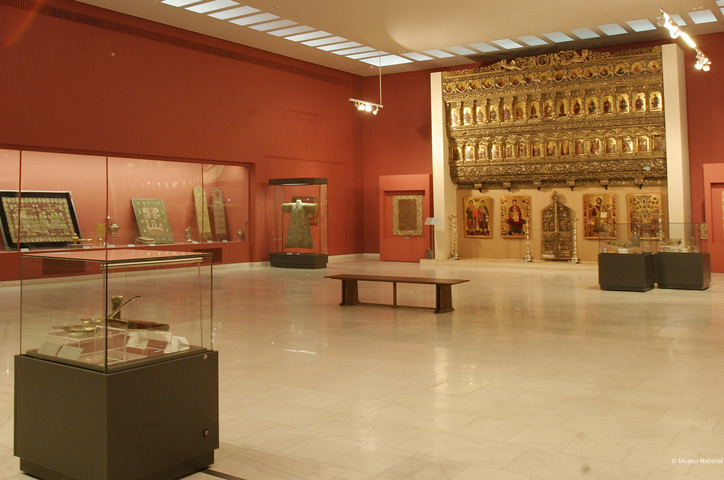
 

See more works in the Romanian Medieval Art Gallery

Romanian Medieval Art Gallery

Romanian Medieval Art Gallery

Over 900 icons, mural paintings, embroideries, manuscripts, silverware, woodcarvings, many of them unique, amply survey Romanian art from the 14th – to the early 19th century. Items on display showcase developments in Moldavia, Wallachia and Transylvania, reflecting the intricate manner in which a traditional Byzantine layer blended in Oriental as well as Western influences to generate original local art forms.

LABORATORY III: ASPECTS OF RESTORING GRAPHIC AND CERAMIC WORKS FROM CHINA AND JAPAN IN THE MNAR  HERITAGE

LABORATORY III: ASPECTS OF RESTORING GRAPHIC AND CERAMIC WORKS FROM CHINA AND JAPAN IN THE MNAR HERITAGE

The exhibition will be open to the public from December 14, 2022, to June 25, 2023.

K.H. Zambaccian Museum

K.H. Zambaccian Museum

Art collector and critic Krikor H. Zambaccian (1889-1962) put together one of the richest and most valuable private collections in Romania. In the 1940s Zambaccian had the house purpose built so as to enable him to display the paintings, sculptures, prints and drawings and furniture he had acquired over more than half a century. Both the collection and the house were donated by him to the Romanian State in 1947.
In celebration of his deed, Zambaccian was made a member of the Romanian Academy.
The collector’s portfolio of Romanian artists offers a brief but dense overview of modern Romanian art, covering representative paintings by founding figures like Theodor Aman, Nicolae Grigorescu, Ioan Andreescu, classical modernists like Ștefan Luchian, Nicolae Tonitza, Theodor Pallady and Gheorghe Petrașcu, and post-war figurative painters like Corneliu Baba, Alexandru Phoebus and Horia Damian. Sculptures by Brâncuși, Milița Petrașcu, Oscar Han and Cornel Medrea reflect Zambaccian’s preference for a more traditional vein of modernism. To create a context for Romanian art and enhance his prestige, Zambaccian also acquired works by Cézanne, Picasso, Matisse, Bonnard, Utrillo, and Marquet, which lend his collection a profile unmatched in Romania.  

Facebook Page

Acest site folosește cookies

Folosim module cookie pentru a vă pune la dispoziție caracteristici de social media și pentru a analiza traficul. Navigând în continuare, vă exprimați acordul asupra folosirii acestora.