Accessibility Tools

Visiting hours:
The National Museum of Art of Romania
, the Theodor Pallady Museum and the K. H. Zambaccian Museum can be visited: Wednesday-Friday 10am-6pm
Saturday-Sunday 11am-7pm, Monday and Tuesday closed. Free entry on the first Wednesday of the month.
The Art Collections Museum: Monday, Tuesday and Friday, 10am-6pm, Saturday and Sunday 11am-7pm, closed Wednesday and Thursday. Free entry on the first Tuesday of the month.
Last entrance: 1 hour before closing for The National Museum of Art of Romania and the Art Collections Museum and 30 minutes for the Theodor Pallady Museum, the K. H. Zambaccian Museum and the temporary exhibitions.
For guided tours, please make a reservation at secretariat@art.museum.ro at least 7 days in advance.
For visits to our museum without guided tours there is no reservation necessary.

Starting with February 4, 2026, the Theodor Pallady Museum is temporarily closed for reorganization and renovation works.

The National Museum of Art of Romania
Procession cross
Artwork description
Procession cross
Carved cypress wood (?), low relief, silver gilt mount
52 x 20,7 x 7 cm
Moldavia
Master Dosoftei from Putna
1561
Inv.15418 / L 475
Artwork location
Romanian Medieval Art Gallery, room 4

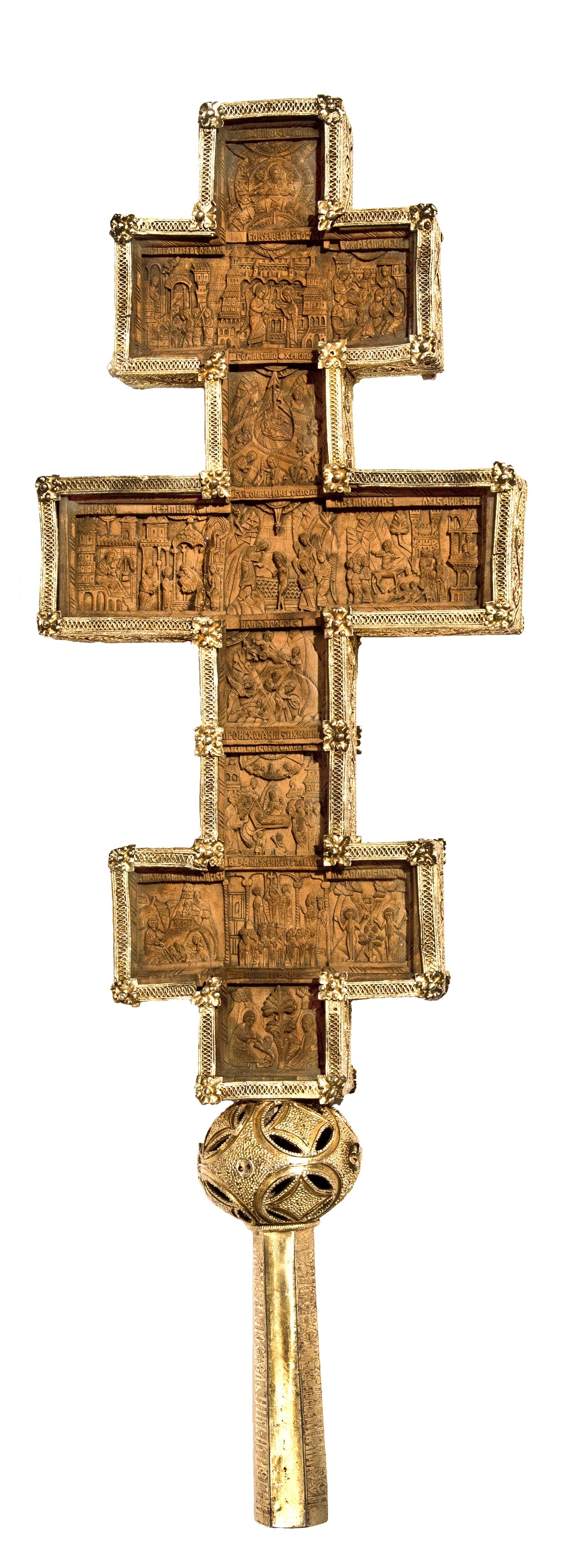
In 1561, master Dosoftei, a monk at the Putna monastery, was ordered a cross for the church of the Slatina Monastery. Matei Crăciun, one of the highest ranking boyars in the country, and his wife Maria commissioned it as a gift for this church, recently founded by Prince Alexandru Lăpuşneanu of Moldavia, and his wife, Ruxandra.

The double-sided 50 cm-high cross has three arms, symbolic of the Crucifixion cross, whose upper arm contained the inscription Jesus of Nazareth, King of the Jews, and the small lower arm supported His nailed feet. The cross is carved in low relief on both sides and has a silver-mount decorated with filigree spiral vegetal motifs fixed at corners with rosettes. The sphere in the silver handle symbolizes the globe.

Each side of the cross contains 16 miniature scenes which recount Jesus’ life and Passions. These are supplemented by several scenes representing local legends which anchor the cross in 16th century Moldavian religious practice. Most scenes are set in or against a complex architectural background while several others are set in ample, suggestive landscapes. Both architecture and landscape strengthen and support the rich narrative while allowing the artist to convincingly conflate certain episodes.


See more works in the Romanian Medieval Art Gallery

The Gallery of Oriental Art

The Gallery of Oriental Art

The Gallery of Oriental Art brings together objects of great artistic and cultural value from Egypt, Greece, Bulgaria, Turkey, Syria, Dagestan, Azerbaijan, Iran, Turkmenistan, Uzbekistan, India, China and Japan, selected from the most important and valuable heritage of Oriental and Far Eastern art in the country.

Devrim Erbil: Istanbul yesterday and today exhibition

Devrim Erbil: Istanbul yesterday and today exhibition

16 November 2023 - 18 February 2024
Curator: Yildiz Ibram

The Art Collections Museum

The Art Collections Museum

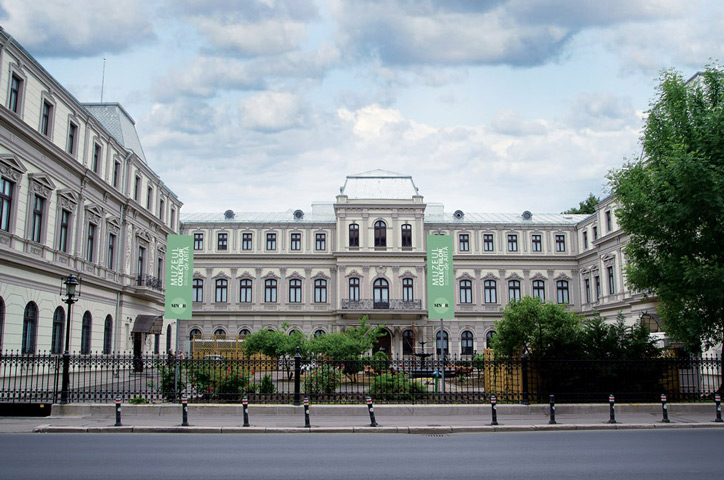
Inaugurated in 1978 as a Department of the National Museum of Art of Romania, the Art Collections Museum showcases artistic interests that prevailed in Romanian society from the early 20th century onward. Over 30 collections on permanent display incorporate a variety of art pieces and collectibles, ranging from Romanian and European fine and decorative arts to Oriental art. Donated over nearly a century by both collectors and artists, they bear witness to their owners’ taste and economic power, their leaning toward famous names or contemporary art, as well as to the artists’ particular interests, surroundings, and daily studio practice. Works by well-known Romanian painters such as Theodor Aman, Nicolae Grigorescu, Ioan Andreescu, Nicolae Tonitza, Gheorghe Petraşcu, Theodor Pallady, Lucian Grigorescu, Iosif Iser, Camil Ressu, Francisc Şirato, Alexandru Ciucurencu, Dimitrie Ghiaţă are exhibited alongside European and Japanese prints and drawings, French furniture, Oriental carpets, and folk icons from Transylvania. This unique museum is hosted by the former Romanit palace. The building, an example of modern Bucharest architecture, was recently restored and refurbished. Wherever possible, displays suggest the original layout and atmosphere of individual collections.

Facebook Page

Acest site folosește cookies

Folosim module cookie pentru a vă pune la dispoziție caracteristici de social media și pentru a analiza traficul. Navigând în continuare, vă exprimați acordul asupra folosirii acestora.