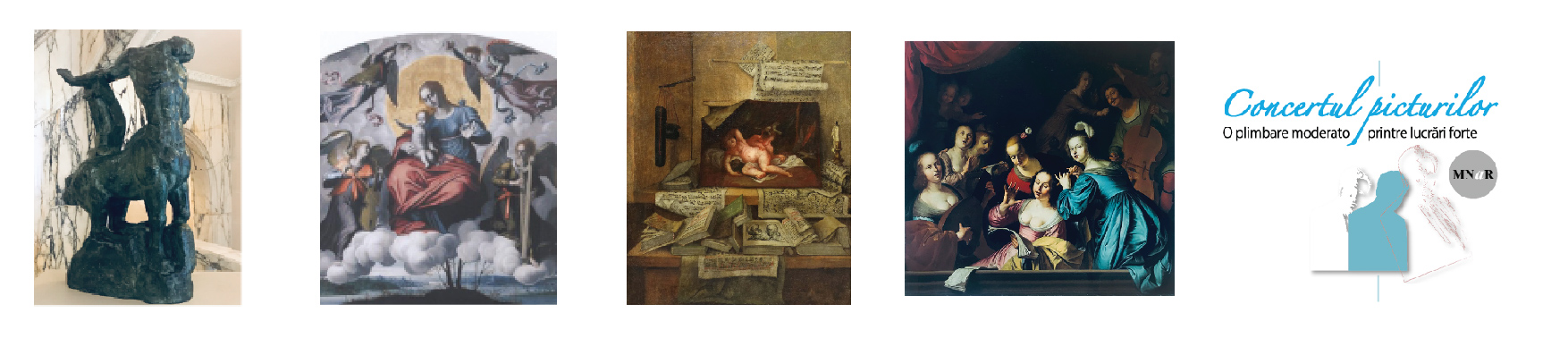
In your tour through the European Art Gallery, while admiring works by great artists such as El Greco, Rubens, Rembrandt or Monet, do not miss the five stops we prepared for the special tour dedicated to music as presented in the artwork on music subjects. You will be persuaded that many European artists were inspired by music, a language not only universal but also beyond time.

Jacopo Amigoni - Portrait of singer Carlo Broschi named Farinelli
The first stop on the musical tour in the European Art Gallery is with the Italian School and the “Portrait of singer Carlo Broschi named Farinelli”. In a grandiose arhitectural decor, the famous castrato Farinelli, presented in full size, is being crowned with laurels by Euterpe, muse of music. The winged feminine character in the background symbolises Fame, while the bust of the god Apollo or the garland lead to the idea of Farinelli’s artistic supremacy.
The author is Jacopo Amigoni (1682-1752), one of the most important representatives of rococo painting in Europe. Amigoni met Farinelli in person and made several portraits of him. The one shown in NMAR is considered the most complex.
Anonymous German artist from the XVIII-th century- Still Life With Music Notes
If you stop in the rooms showing works belonging to the German school, you can admire a XVIII-th century still life, painted in trompe l’oeil. The objects are exhibited on two wooden shelves, with a wall as a background. In the centre of the composition one discovers a small painting representing two children and several pigeons; the small painting is surrounded by music sheets. In the upper left register there is a knife thrust into the wall and from it an inkpot and a sheath for pens are hanging.
This work is now shown especially for the Campaign entitled The Concert of Paintings. A „moderato” walk among „forte” artwork.
Pedro Campaña – The Triumph of the Virgin Surrounded by Angels
For the third stop on this musical trip we propose a Renaissance religious work from the Spanish School: ”The Triumph of the Virgin Surrounded by Angels”. This painting shows the Virgin Mary holding baby Jesus in her arms. She is surrounded by four angels, two of them holding in their hands a harp and a violin. Musical themes are often present in religious works and they usually symbolize celestial harmony.
This painting was created by Pedro Campaña (1503–1580), considered to be one of the greatest religious painters in Seville by the mid-XVI-th century. Mainly inspired by Rafael, Peter de Kempeneer -- by his original name -- was a true Renaissance artist: painter, architect, sculptor, mathematician, astrologist, engineer.
Abraham Van der Schoor – The Concert
For a tour entitled „The Concert of Paintings”, the piece „The Concert”, shown in the Dutch School Rooms, is an absolute must.
In the XVII-th century, music was a popular passtime among the middle classes. Thus, such picturesque images, of musicians and robust singers, seen by the Flemish painters in theatrical lightings, exerted a powerful attraction on the Dutch artistic milieu. Abraham Van der Schoor, author of this painting, obviously did not escape it.
There are few informations on his life and career. But from the few of his works that reached us, one can see his attraction for the topic of the concert.
Émile-Antoine Bourdelle – Dying Centaur (second study)
Last stop: French School Rooms, to see the only sculpture on this musical trip. Made in bronze in 1914 by Émile-Antoine Bourdelle (1861 – 1929), the sculpture ”Dying Centaur” symbolises the sad destiny of an artist who wrestles with his own life and dies holding his lyre that represents his artistic ideal. A melancholic work on the death of the artist no longer credited by his audience.
Considered one of the most important modern sculptors, Bourdelle was an apprentice in the workshop of Auguste Rodin, whose influence is visible in Bourdelle’s early work.